


HomeSleep BetterWhy Is Eating Before Sleeping a Bad Idea? What Dr. Rhonda Patrick Says
Why Is Eating Before Sleeping a Bad Idea?

Why Is Eating Before Sleeping a Bad Idea? What Dr. Rhonda Patrick Says

Quick answer: Why is eating before sleeping a bad idea? Late meals can disrupt sleep. Dr. Rhonda Patrick advises stopping about three hours before bed. Research links eating within that window to more nighttime awakenings and reflux, and an extended overnight fast improved blood-pressure dipping in one small trial. Evidence on sleep itself is mixed.

Key facts at a glance:

  • The rule: Dr. Rhonda Patrick says to stop eating about three hours before bed.
  • Survey data: A university survey linked eating within three hours of bedtime to nighttime awakenings (odds ratio 1.61).
  • Counter-evidence: A 2021 crossover study of 20 healthy adults found no significant adverse changes in sleep architecture after a late dinner.
  • Blood pressure: A 2026 trial of 39 adults found that finishing food at least three hours before sleep improved nighttime diastolic blood-pressure dipping by about 3.5 percentage points.
  • Reflux: The NIDDK says doctors may recommend people with GERD eat meals 2 to 3 hours before lying down.
  • If you are hungry: Patrick suggests something light, such as a protein shake with almond milk.

Why is eating before sleeping a bad idea when a late snack feels so comforting? Dr. Rhonda Patrick, a biomedical scientist and founder of FoundMyFitness, offers a simple rule. Stop eating about three hours before bed. In a podcast interview, she explained her reasoning in plain language.

This article explains the rule, tests each claim against published research, and shows where the evidence is strong or mixed. It also lists who should adjust the advice. Every study below is linked, so you can check it yourself.

Who Is Dr. Rhonda Patrick?

Dr. Rhonda Patrick is a biomedical scientist and the founder of FoundMyFitness, a science website, podcast, and YouTube channel. According to a profile on the Bruce Ames lab site, she earned her PhD in biomedical science from the University of Tennessee Health Science Center and St. Jude Children’s Research Hospital. She then trained as a postdoctoral fellow at Children’s Hospital Oakland Research Institute with Dr. Bruce Ames. FoundMyFitness adds that she researched insulin signaling and protein misfolding at the Salk Institute.

One caveat applies. FoundMyFitness is her own media platform and membership service, so independent studies matter. This article therefore links each claim to its underlying research.

What Is the Three-Hour Rule?

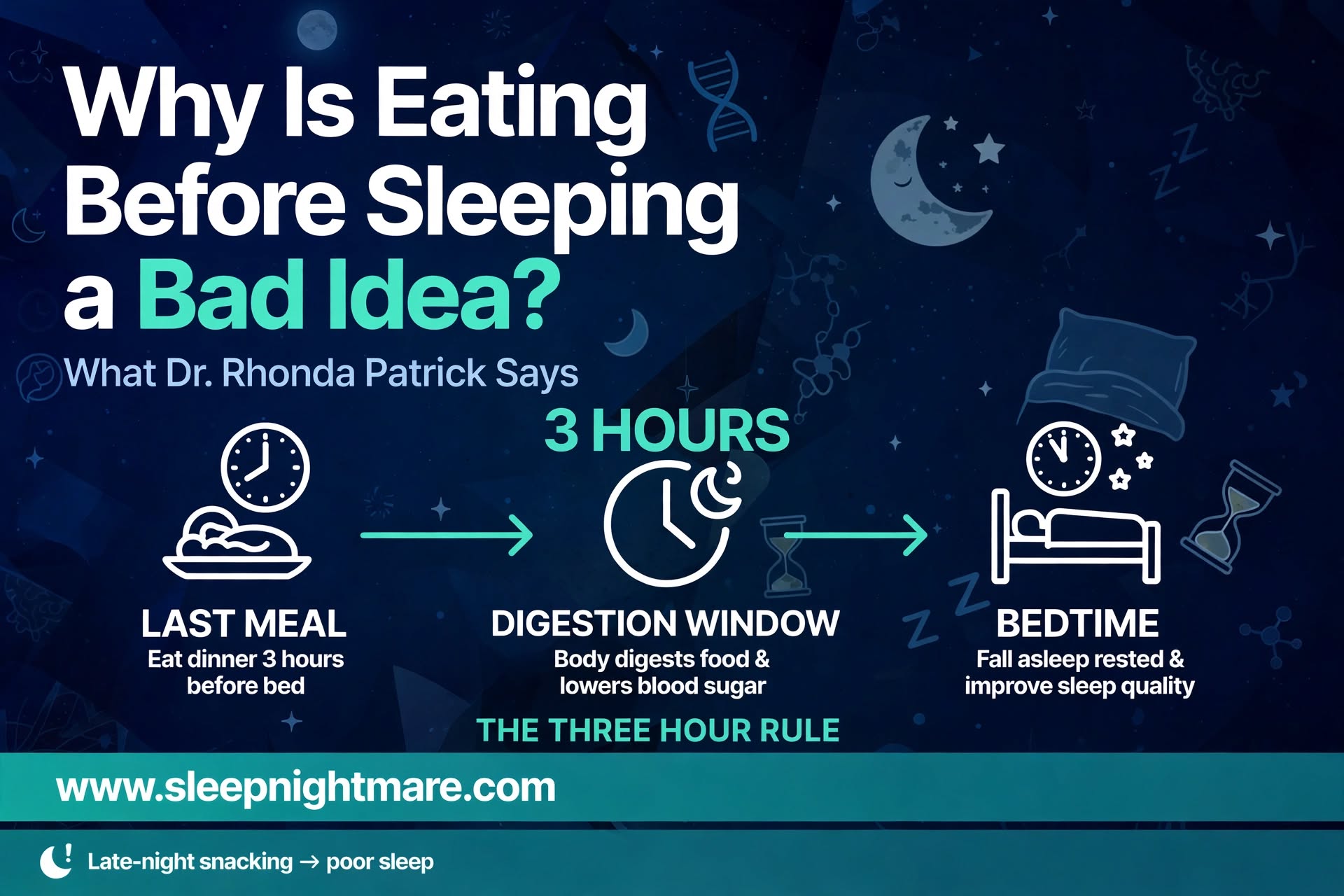
The three-hour rule means finishing your last meal about three hours before bedtime. Dr. Rhonda Patrick calls three hours the “magic number” in multiple studies. For example, if you go to bed at 9 p.m., you would stop eating by 6 p.m. She distinguishes a full meal from a light snack.

Here is how she puts it in the interview:

“It’s not a good idea to eat a meal fewer than three hours before bed, so you want to stop eating three hours before bed.” — Dr. Rhonda Patrick

The 9 p.m. example comes from her FoundMyFitness write-up. There she adds that digestion takes about five hours on average to finish after you stop eating. Elsewhere, she notes that digestion time varies with meal size, composition, health, and medication use. Treat three hours as a practical buffer, not a precise physiological line.

Why Is Eating Before Sleeping a Bad Idea for Your Nervous System?

Dr. Rhonda Patrick says a meal activates the sympathetic nervous system, the body’s fight-or-flight system, which is the opposite of what you want at bedtime. She has also noted, however, that fed and fasted states are not a simple sympathetic-versus-parasympathetic switch, because digestion also relies on parasympathetic function.

Her core argument in the interview is this:

“When you eat a meal, it is activating your sympathetic nervous system. That’s the fight or flight response. That’s not what you want active when you’re about to go to bed.” — Dr. Rhonda Patrick

In her FoundMyFitness explainer, she describes the sympathetic system as the one that switches you on before you go on stage. She contrasts it with the parasympathetic system, which she wants more active during wind-down. So the mechanism is plausible but not settled. The studies below test sleep and body-rhythm outcomes, not nerve activity directly.

Why Is Eating Before Sleeping a Bad Idea for Sleep Quality?

Evidence is mixed. A university survey linked eating within three hours of bedtime to waking at night, with an odds ratio of 1.61. A laboratory trial of 20 healthy adults found no significant adverse changes in sleep architecture after dinner one hour before bed. Both findings matter for how strictly you apply the rule.

Patrick describes the problem in these terms:

“Even if you’re sleeping, it’s not good sleep. It’s fragmented sleep.” — Dr. Rhonda Patrick

Observational data partly support her. In a cross-sectional survey of university students, eating within three hours of bedtime was associated with at least one nocturnal awakening (odds ratio 1.61; 95% CI 1.15–2.27). It was not associated with long sleep-onset latency or short sleep duration. Because students reported their own sleep, the survey shows association, not cause.

The lab data are less clear. In a 2021 randomized crossover study, 20 healthy adults ate dinner either five hours or one hour before bedtime. Conventional sleep stages were similar. The late dinner was linked to deeper sleep early in the night and lighter sleep later. Patrick herself notes on FoundMyFitness that sleep findings are mixed.

Why Is Eating Before Sleeping a Bad Idea for Acid Reflux?

Reflux is one reason for some people. Researchers think meals near sleep onset contribute to poor sleep through gastrointestinal discomfort, heartburn, and reflux. The NIDDK says doctors may recommend that people with GERD eat meals 2 to 3 hours before lying down. Reflux is a separate mechanism from the nervous-system explanation.

The survey authors state this reflux idea in their introduction. The NIDDK guide to acid reflux in adults lists eating meals 2 to 3 hours before lying down among lifestyle steps. Those steps sit beside weight loss and avoiding trigger foods. Patrick’s three-hour rule therefore overlaps with standard reflux guidance, even though her main argument is about the nervous system.

If you have frequent heartburn, speak with a doctor. Lifestyle changes help, but persistent symptoms need medical advice.

How Does Late Eating Affect Blood Pressure and Blood Sugar?

Late eating may blunt the normal nighttime drop in blood pressure and worsen glucose control, according to small studies. In a 2026 randomized trial of 39 adults, ending food intake at least three hours before sleep improved nighttime diastolic blood-pressure dipping by about 3.5 percentage points. Researchers measured short-term physiology, not heart attacks.

The trial, published in Arteriosclerosis, Thrombosis, and Vascular Biology, studied adults with overweight or obesity over about 7.5 weeks. Participants extended their overnight fast to 13 to 16 hours. According to FoundMyFitness, nighttime diastolic pressure also fell by about 1.8 mm Hg. Patrick notes the trial did not improve its primary insulin-sensitivity outcome or measured sleep.

Glucose evidence points the same way. Patrick says melatonin starts rising about three hours before natural bedtime and can reduce insulin secretion. She clarifies that this does not mean the pancreas stops making insulin. In a randomized crossover trial of healthy volunteers, a 10 p.m. dinner raised nighttime glucose compared with a 6 p.m. dinner, as summarized by FoundMyFitness. Sleep architecture did not change.

Should You Stay Up for Three Hours After a Late Meal?

No. If you eat late, go to bed rather than staying up, says Dr. Rhonda Patrick. In the interview, she answers a midnight-meal scenario directly: do not wait until 3 a.m. She cautions only against making late meals a daily habit, not against an occasional one.

The host asked whether someone who eats at midnight should stay awake until 3 a.m. Her answer was short:

“No, no, you should just go to bed, but don’t do it on a daily basis.” — Dr. Rhonda Patrick

The practical lesson is flexibility. The rule works as a habit, not a nightly test of willpower.

What Can You Eat Before Bed If You Are Hungry?

If you need to eat before bed, Dr. Rhonda Patrick recommends something light. Her example is a protein shake with almond milk. FoundMyFitness adds that a bedtime buffer is especially useful for large or carbohydrate-rich meals, while individual factors such as chronotype, reflux, and metabolic health still matter.

In her words:

“If you need to eat something before bed, you should do something that’s light, maybe a protein shake with some almond milk.” — Dr. Rhonda Patrick

This is a fallback, not a nightly meal plan. The FoundMyFitness summary stresses that responses vary with meal composition and metabolic health. If you manage a health condition, ask a clinician what snack suits you.

What Does the Research Say? An Evidence Summary

So, why is eating before sleeping a bad idea, according to the evidence? Research supports a three-hour buffer more strongly for reflux and blood-pressure rhythm than for sleep itself. Observational data link late meals to nighttime awakenings. Laboratory trials show mixed or null sleep results. The table summarizes what each study tested and what it cannot tell you.

SourceDesignKey findingLimitation
University student surveyCross-sectional surveyEating within 3 h of bedtime linked to nocturnal awakening (OR 1.61)Self-reported sleep; association only
Duan et al., 2021Randomized crossover, 20 healthy adultsDinner 1 h vs 5 h before bed: no significant adverse change in sleep architectureSmall, healthy, laboratory setting
Gu et al., 2020Randomized crossover, healthy volunteers10 p.m. dinner raised nighttime glucose; sleep architecture unchanged (per FoundMyFitness)Metabolic outcome, not sleep quality
Grimaldi et al., 2026Randomized trial, 39 adults with obesityLast meal 3 h+ before sleep improved diastolic dipping by about 3.5 pointsDid not improve measured sleep; small
NIDDKClinical guidanceFor GERD, eat meals 2 to 3 h before lying downApplies to reflux, not all sleepers

Who Should Not Follow the Three-Hour Rule Strictly?

People with certain health or training needs may need a different schedule. FoundMyFitness lists diabetes medication, reflux, pregnancy, eating-disorder history, low energy availability, and demanding training as cases where individual needs can take priority. Check with a clinician before changing meal timing if any of these apply.

The FoundMyFitness note also calls the two-to-three-hour buffer an option, not a universal rule. That framing is worth keeping. Meal timing is one lever, and it works best alongside a consistent sleep schedule and a clinician’s advice for any medical condition.

How Can You Apply the Three-Hour Rule?

Timing is the main issue. To apply the three-hour rule, pick your bedtime, count back three hours, and make that your kitchen-closing time. Move dinner earlier if needed. If hunger strikes later, choose something light. Track how you sleep for two weeks to see whether the change helps you.

  1. Pick your usual bedtime. Use the time you actually fall asleep, not your ideal one.
  2. Count back three hours. If you sleep at 10 p.m., stop eating at 7 p.m.
  3. Move dinner earlier. Healthline suggests a short walk or light chores to delay lying down after a meal.
  4. Keep a light fallback. Patrick’s example is a protein shake with almond milk.
  5. Note the results. Jot down awakenings and morning energy for two weeks.

No. Meal timing is one of several nutrition-related influences on sleep. Caffeine timing matters, too, especially late in the day. Another proposed factor is vitamin D, which neurologist Dr. Stasha Gominak links to REM sleep, though that idea remains a hypothesis rather than settled science.

Our review of vitamin D and sleep examines Gominak’s hypothesis and the published research behind it. For caffeine, our guide on how to take a nap easily with the coffee nap method explains why an early-afternoon nap beats a late one.

Conclusion

Why is eating before sleeping a bad idea? The honest answer is that late meals may interrupt sleep, raise reflux risk, and blunt the nighttime blood-pressure dip. The evidence is strongest for reflux guidance and weaker for sleep quality itself.

Dr. Rhonda Patrick’s rule is simple and low-risk for most people. Stop eating about three hours before bed, keep any bedtime snack light, and do not stress over an occasional late meal. If you have reflux, diabetes, or another condition, talk to a clinician first.

Frequently Asked Questions

Why is eating before sleeping a bad idea?

Late meals may interrupt sleep. A survey of university students linked eating within three hours of bedtime to more nighttime awakenings (odds ratio 1.61). Dr. Rhonda Patrick adds that digestion activates the sympathetic nervous system. However, a small laboratory trial found no significant adverse changes in sleep architecture after a late dinner, so evidence is mixed. (Student survey; Duan et al., 2021)

How long before bed should you stop eating?

Dr. Rhonda Patrick recommends stopping about three hours before bed. If you go to bed at 9 p.m., she says, stop eating at 6 p.m. The NIDDK separately advises people with reflux to eat 2 to 3 hours before lying down. A 2026 trial used a final meal at least three hours before sleep. (NIDDK)

Does eating before bed cause fragmented sleep?

It may. In a student survey, eating within three hours of bedtime was linked to nocturnal awakenings (odds ratio 1.61) but not to slow sleep onset or short sleep. Dr. Patrick calls this fragmented sleep. Yet a 2021 crossover study of 20 healthy adults found similar sleep stages after dinner one hour before bed. (PubMed Central)

What if you eat late once in a while?

Dr. Rhonda Patrick says you should simply go to bed, not stay up waiting out the three hours. For example, if you eat at midnight, do not stay awake until 3 a.m. She stresses that this should not become a daily habit.

What can you eat before bed if you are hungry?

Dr. Patrick suggests something light, such as a protein shake with almond milk. FoundMyFitness notes the bedtime buffer is especially useful for large or carbohydrate-rich meals. Individual needs vary, especially with reflux or diabetes medication, so check with a clinician if you manage a health condition. (FoundMyFitness)

Who should not stop eating three hours before bed?

FoundMyFitness lists people managing diabetes medication, reflux, pregnancy, an eating-disorder history, low energy availability, or demanding training as cases where individual needs may take priority. If any applies, talk to your clinician before changing meal timing. The three-hour buffer is an option, not a universal rule. (FoundMyFitness)

Sources

  1. Bruce Ames Lab. Rhonda Patrick, Post-Doctoral Scientist.
  2. FoundMyFitness. About Dr. Rhonda Patrick.
  3. FoundMyFitness. How Late-Night Eating Affects Sleep, Glucose, and Blood Pressure. Posted August 7, 2026.
  4. FoundMyFitness. A Small Trial Tested Meal Timing and Nighttime Blood Pressure. Posted April 22, 2026.
  5. Grimaldi D, Reid KJ, Abbott SM, Knutson KL, Zee PC. Sleep-aligned extended overnight fasting improves nighttime and daytime cardiometabolic function. Arteriosclerosis, Thrombosis, and Vascular Biology. 2026.
  6. Duan D, Gu C, Polotsky VY, Jun JC, Pham LV. Effects of dinner timing on sleep stage distribution and EEG power spectrum in healthy volunteers. Nature and Science of Sleep. 2021;13:601-612.
  7. Does the proximity of meals to bedtime influence the sleep of young adults? A cross-sectional survey of university students. PubMed Central.
  8. Gu C, Brereton N, Schweitzer A, et al. Metabolic effects of late dinner in healthy volunteers: a randomized crossover clinical trial. 2020.
  9. National Institute of Diabetes and Digestive and Kidney Diseases. Acid reflux (GER and GERD) in adults.
  10. Healthline. GERD and sleep: lifestyle changes.

Quick answer: Why is eating before sleeping a bad idea? Late meals can disrupt sleep. Dr. Rhonda Patrick advises stopping about three hours before bed. Research links eating within that window to more nighttime awakenings and reflux, and an extended overnight fast improved blood-pressure dipping in one small trial. Evidence on sleep itself is mixed.

Key facts at a glance:

  • The rule: Dr. Rhonda Patrick says to stop eating about three hours before bed.
  • Survey data: A university survey linked eating within three hours of bedtime to nighttime awakenings (odds ratio 1.61).
  • Counter-evidence: A 2021 crossover study of 20 healthy adults found no significant adverse changes in sleep architecture after a late dinner.
  • Blood pressure: A 2026 trial of 39 adults found that finishing food at least three hours before sleep improved nighttime diastolic blood-pressure dipping by about 3.5 percentage points.
  • Reflux: The NIDDK says doctors may recommend people with GERD eat meals 2 to 3 hours before lying down.
  • If you are hungry: Patrick suggests something light, such as a protein shake with almond milk.

Why is eating before sleeping a bad idea when a late snack feels so comforting? Dr. Rhonda Patrick, a biomedical scientist and founder of FoundMyFitness, offers a simple rule. Stop eating about three hours before bed. In a podcast interview, she explained her reasoning in plain language.

This article explains the rule, tests each claim against published research, and shows where the evidence is strong or mixed. It also lists who should adjust the advice. Every study below is linked, so you can check it yourself.

Who Is Dr. Rhonda Patrick?

Dr. Rhonda Patrick is a biomedical scientist and the founder of FoundMyFitness, a science website, podcast, and YouTube channel. According to a profile on the Bruce Ames lab site, she earned her PhD in biomedical science from the University of Tennessee Health Science Center and St. Jude Children’s Research Hospital. She then trained as a postdoctoral fellow at Children’s Hospital Oakland Research Institute with Dr. Bruce Ames. FoundMyFitness adds that she researched insulin signaling and protein misfolding at the Salk Institute.

One caveat applies. FoundMyFitness is her own media platform and membership service, so independent studies matter. This article therefore links each claim to its underlying research.

What Is the Three-Hour Rule?

The three-hour rule means finishing your last meal about three hours before bedtime. Dr. Rhonda Patrick calls three hours the “magic number” in multiple studies. For example, if you go to bed at 9 p.m., you would stop eating by 6 p.m. She distinguishes a full meal from a light snack.

Here is how she puts it in the interview:

“It’s not a good idea to eat a meal fewer than three hours before bed, so you want to stop eating three hours before bed.” — Dr. Rhonda Patrick

The 9 p.m. example comes from her FoundMyFitness write-up. There she adds that digestion takes about five hours on average to finish after you stop eating. Elsewhere, she notes that digestion time varies with meal size, composition, health, and medication use. Treat three hours as a practical buffer, not a precise physiological line.

Why Is Eating Before Sleeping a Bad Idea for Your Nervous System?

Dr. Rhonda Patrick says a meal activates the sympathetic nervous system, the body’s fight-or-flight system, which is the opposite of what you want at bedtime. She has also noted, however, that fed and fasted states are not a simple sympathetic-versus-parasympathetic switch, because digestion also relies on parasympathetic function.

Her core argument in the interview is this:

“When you eat a meal, it is activating your sympathetic nervous system. That’s the fight or flight response. That’s not what you want active when you’re about to go to bed.” — Dr. Rhonda Patrick

In her FoundMyFitness explainer, she describes the sympathetic system as the one that switches you on before you go on stage. She contrasts it with the parasympathetic system, which she wants more active during wind-down. So the mechanism is plausible but not settled. The studies below test sleep and body-rhythm outcomes, not nerve activity directly.

Why Is Eating Before Sleeping a Bad Idea for Sleep Quality?

Evidence is mixed. A university survey linked eating within three hours of bedtime to waking at night, with an odds ratio of 1.61. A laboratory trial of 20 healthy adults found no significant adverse changes in sleep architecture after dinner one hour before bed. Both findings matter for how strictly you apply the rule.

Patrick describes the problem in these terms:

“Even if you’re sleeping, it’s not good sleep. It’s fragmented sleep.” — Dr. Rhonda Patrick

Observational data partly support her. In a cross-sectional survey of university students, eating within three hours of bedtime was associated with at least one nocturnal awakening (odds ratio 1.61; 95% CI 1.15–2.27). It was not associated with long sleep-onset latency or short sleep duration. Because students reported their own sleep, the survey shows association, not cause.

The lab data are less clear. In a 2021 randomized crossover study, 20 healthy adults ate dinner either five hours or one hour before bedtime. Conventional sleep stages were similar. The late dinner was linked to deeper sleep early in the night and lighter sleep later. Patrick herself notes on FoundMyFitness that sleep findings are mixed.

Why Is Eating Before Sleeping a Bad Idea for Acid Reflux?

Reflux is one reason for some people. Researchers think meals near sleep onset contribute to poor sleep through gastrointestinal discomfort, heartburn, and reflux. The NIDDK says doctors may recommend that people with GERD eat meals 2 to 3 hours before lying down. Reflux is a separate mechanism from the nervous-system explanation.

The survey authors state this reflux idea in their introduction. The NIDDK guide to acid reflux in adults lists eating meals 2 to 3 hours before lying down among lifestyle steps. Those steps sit beside weight loss and avoiding trigger foods. Patrick’s three-hour rule therefore overlaps with standard reflux guidance, even though her main argument is about the nervous system.

If you have frequent heartburn, speak with a doctor. Lifestyle changes help, but persistent symptoms need medical advice.

How Does Late Eating Affect Blood Pressure and Blood Sugar?

Late eating may blunt the normal nighttime drop in blood pressure and worsen glucose control, according to small studies. In a 2026 randomized trial of 39 adults, ending food intake at least three hours before sleep improved nighttime diastolic blood-pressure dipping by about 3.5 percentage points. Researchers measured short-term physiology, not heart attacks.

The trial, published in Arteriosclerosis, Thrombosis, and Vascular Biology, studied adults with overweight or obesity over about 7.5 weeks. Participants extended their overnight fast to 13 to 16 hours. According to FoundMyFitness, nighttime diastolic pressure also fell by about 1.8 mm Hg. Patrick notes the trial did not improve its primary insulin-sensitivity outcome or measured sleep.

Glucose evidence points the same way. Patrick says melatonin starts rising about three hours before natural bedtime and can reduce insulin secretion. She clarifies that this does not mean the pancreas stops making insulin. In a randomized crossover trial of healthy volunteers, a 10 p.m. dinner raised nighttime glucose compared with a 6 p.m. dinner, as summarized by FoundMyFitness. Sleep architecture did not change.

Should You Stay Up for Three Hours After a Late Meal?

No. If you eat late, go to bed rather than staying up, says Dr. Rhonda Patrick. In the interview, she answers a midnight-meal scenario directly: do not wait until 3 a.m. She cautions only against making late meals a daily habit, not against an occasional one.

The host asked whether someone who eats at midnight should stay awake until 3 a.m. Her answer was short:

“No, no, you should just go to bed, but don’t do it on a daily basis.” — Dr. Rhonda Patrick

The practical lesson is flexibility. The rule works as a habit, not a nightly test of willpower.

What Can You Eat Before Bed If You Are Hungry?

If you need to eat before bed, Dr. Rhonda Patrick recommends something light. Her example is a protein shake with almond milk. FoundMyFitness adds that a bedtime buffer is especially useful for large or carbohydrate-rich meals, while individual factors such as chronotype, reflux, and metabolic health still matter.

In her words:

“If you need to eat something before bed, you should do something that’s light, maybe a protein shake with some almond milk.” — Dr. Rhonda Patrick

This is a fallback, not a nightly meal plan. The FoundMyFitness summary stresses that responses vary with meal composition and metabolic health. If you manage a health condition, ask a clinician what snack suits you.

What Does the Research Say? An Evidence Summary

So, why is eating before sleeping a bad idea, according to the evidence? Research supports a three-hour buffer more strongly for reflux and blood-pressure rhythm than for sleep itself. Observational data link late meals to nighttime awakenings. Laboratory trials show mixed or null sleep results. The table summarizes what each study tested and what it cannot tell you.

SourceDesignKey findingLimitation
University student surveyCross-sectional surveyEating within 3 h of bedtime linked to nocturnal awakening (OR 1.61)Self-reported sleep; association only
Duan et al., 2021Randomized crossover, 20 healthy adultsDinner 1 h vs 5 h before bed: no significant adverse change in sleep architectureSmall, healthy, laboratory setting
Gu et al., 2020Randomized crossover, healthy volunteers10 p.m. dinner raised nighttime glucose; sleep architecture unchanged (per FoundMyFitness)Metabolic outcome, not sleep quality
Grimaldi et al., 2026Randomized trial, 39 adults with obesityLast meal 3 h+ before sleep improved diastolic dipping by about 3.5 pointsDid not improve measured sleep; small
NIDDKClinical guidanceFor GERD, eat meals 2 to 3 h before lying downApplies to reflux, not all sleepers

Who Should Not Follow the Three-Hour Rule Strictly?

People with certain health or training needs may need a different schedule. FoundMyFitness lists diabetes medication, reflux, pregnancy, eating-disorder history, low energy availability, and demanding training as cases where individual needs can take priority. Check with a clinician before changing meal timing if any of these apply.

The FoundMyFitness note also calls the two-to-three-hour buffer an option, not a universal rule. That framing is worth keeping. Meal timing is one lever, and it works best alongside a consistent sleep schedule and a clinician’s advice for any medical condition.

How Can You Apply the Three-Hour Rule?

Timing is the main issue. To apply the three-hour rule, pick your bedtime, count back three hours, and make that your kitchen-closing time. Move dinner earlier if needed. If hunger strikes later, choose something light. Track how you sleep for two weeks to see whether the change helps you.

  1. Pick your usual bedtime. Use the time you actually fall asleep, not your ideal one.
  2. Count back three hours. If you sleep at 10 p.m., stop eating at 7 p.m.
  3. Move dinner earlier. Healthline suggests a short walk or light chores to delay lying down after a meal.
  4. Keep a light fallback. Patrick’s example is a protein shake with almond milk.
  5. Note the results. Jot down awakenings and morning energy for two weeks.

No. Meal timing is one of several nutrition-related influences on sleep. Caffeine timing matters, too, especially late in the day. Another proposed factor is vitamin D, which neurologist Dr. Stasha Gominak links to REM sleep, though that idea remains a hypothesis rather than settled science.

Our review of vitamin D and sleep examines Gominak’s hypothesis and the published research behind it. For caffeine, our guide on how to take a nap easily with the coffee nap method explains why an early-afternoon nap beats a late one.

Conclusion

Why is eating before sleeping a bad idea? The honest answer is that late meals may interrupt sleep, raise reflux risk, and blunt the nighttime blood-pressure dip. The evidence is strongest for reflux guidance and weaker for sleep quality itself.

Dr. Rhonda Patrick’s rule is simple and low-risk for most people. Stop eating about three hours before bed, keep any bedtime snack light, and do not stress over an occasional late meal. If you have reflux, diabetes, or another condition, talk to a clinician first.

Frequently Asked Questions

Why is eating before sleeping a bad idea?

Late meals may interrupt sleep. A survey of university students linked eating within three hours of bedtime to more nighttime awakenings (odds ratio 1.61). Dr. Rhonda Patrick adds that digestion activates the sympathetic nervous system. However, a small laboratory trial found no significant adverse changes in sleep architecture after a late dinner, so evidence is mixed. (Student survey; Duan et al., 2021)

How long before bed should you stop eating?

Dr. Rhonda Patrick recommends stopping about three hours before bed. If you go to bed at 9 p.m., she says, stop eating at 6 p.m. The NIDDK separately advises people with reflux to eat 2 to 3 hours before lying down. A 2026 trial used a final meal at least three hours before sleep. (NIDDK)

Does eating before bed cause fragmented sleep?

It may. In a student survey, eating within three hours of bedtime was linked to nocturnal awakenings (odds ratio 1.61) but not to slow sleep onset or short sleep. Dr. Patrick calls this fragmented sleep. Yet a 2021 crossover study of 20 healthy adults found similar sleep stages after dinner one hour before bed. (PubMed Central)

What if you eat late once in a while?

Dr. Rhonda Patrick says you should simply go to bed, not stay up waiting out the three hours. For example, if you eat at midnight, do not stay awake until 3 a.m. She stresses that this should not become a daily habit.

What can you eat before bed if you are hungry?

Dr. Patrick suggests something light, such as a protein shake with almond milk. FoundMyFitness notes the bedtime buffer is especially useful for large or carbohydrate-rich meals. Individual needs vary, especially with reflux or diabetes medication, so check with a clinician if you manage a health condition. (FoundMyFitness)

Who should not stop eating three hours before bed?

FoundMyFitness lists people managing diabetes medication, reflux, pregnancy, an eating-disorder history, low energy availability, or demanding training as cases where individual needs may take priority. If any applies, talk to your clinician before changing meal timing. The three-hour buffer is an option, not a universal rule. (FoundMyFitness)

Sources

  1. Bruce Ames Lab. Rhonda Patrick, Post-Doctoral Scientist.
  2. FoundMyFitness. About Dr. Rhonda Patrick.
  3. FoundMyFitness. How Late-Night Eating Affects Sleep, Glucose, and Blood Pressure. Posted August 7, 2026.
  4. FoundMyFitness. A Small Trial Tested Meal Timing and Nighttime Blood Pressure. Posted April 22, 2026.
  5. Grimaldi D, Reid KJ, Abbott SM, Knutson KL, Zee PC. Sleep-aligned extended overnight fasting improves nighttime and daytime cardiometabolic function. Arteriosclerosis, Thrombosis, and Vascular Biology. 2026.
  6. Duan D, Gu C, Polotsky VY, Jun JC, Pham LV. Effects of dinner timing on sleep stage distribution and EEG power spectrum in healthy volunteers. Nature and Science of Sleep. 2021;13:601-612.
  7. Does the proximity of meals to bedtime influence the sleep of young adults? A cross-sectional survey of university students. PubMed Central.
  8. Gu C, Brereton N, Schweitzer A, et al. Metabolic effects of late dinner in healthy volunteers: a randomized crossover clinical trial. 2020.
  9. National Institute of Diabetes and Digestive and Kidney Diseases. Acid reflux (GER and GERD) in adults.
  10. Healthline. GERD and sleep: lifestyle changes.

No Comments