
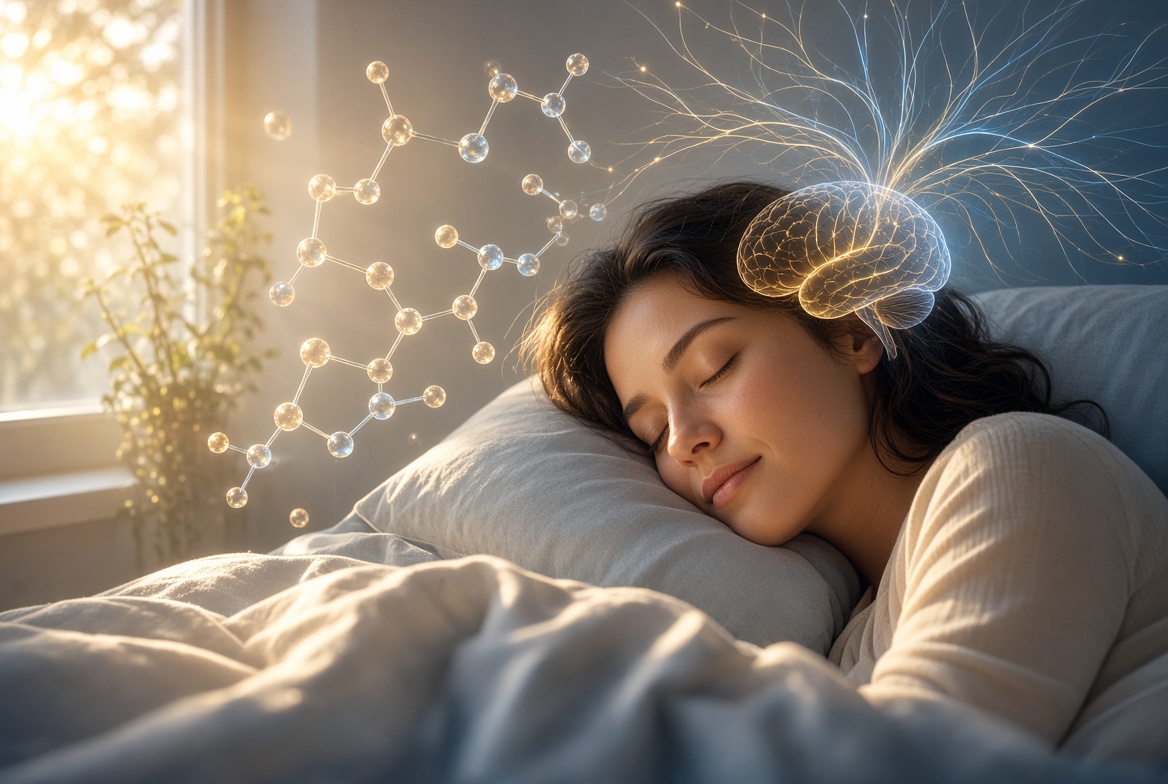


Vitamin D and sleep are connected in ways that most bedtime advice never mentions. Neurologist Dr. Stasha Gominak treated patients who had tried blackout curtains, white noise, and strict bedtimes. They still slept badly. In a recent podcast interview, she explained why she suspects a vitamin D deficiency sits behind the problem. This article walks through her argument, checks it against published research, and separates what is established from what remains a hypothesis.
What Is the Link Between Vitamin D and Sleep?
Vitamin D and sleep appear connected in research, though the cause is unproven. A 2018 meta-analysis found that people with low vitamin D had higher odds of sleep disorders. Dr. Gominak goes further. She proposes that deficiency disrupts brainstem sleep control, and that restoring vitamin D can repair sleep.
The 2018 meta-analysis in Nutrients pooled nine studies with 9,397 participants. It reported that vitamin D deficiency raised the odds of sleep disorders, with an odds ratio of 1.50. However, most of those studies were cross-sectional, so they show association rather than causation. The authors themselves called for more cohort studies and randomized trials.
Why Are So Many People Struggling With Sleep?
Poor sleep is common. According to a 2026 CDC National Center for Health Statistics report, 30.5% of U.S. adults slept less than seven hours in 2024. Only 54.8% woke up feeling well-rested. Meanwhile, 18.1% had trouble staying asleep.
Dr. Gominak points to a lifestyle shift as the root cause. She argues that sunscreen, computers, and air conditioning pushed people indoors starting in the 1980s. In her words:
“This is actually a chemical deficiency state that happens when you move indoors.” — Dr. Stasha Gominak
That timeline is her argument, not an established cause. Still, the NIH Office of Dietary Supplements confirms that skin makes vitamin D when ultraviolet rays from sunlight hit it. Less time outdoors can therefore mean less natural vitamin D.
Who Is Dr. Stasha Gominak?
Dr. Gominak earned her MD from Baylor College of Medicine in 1983, according to her course host, Psychiatry Redefined. She later practiced neurology in Tyler, Texas. In the interview, she estimates she treated about 2,000 patients in clinic. Her online sleep coaching, she says, reached another 5,000 to 6,000 people. Those figures are her own estimates.
In 2012, she and William Stumpf of the University of North Carolina published a hypothesis paper in Medical Hypotheses. It proposed that widespread vitamin D deficiency fueled the epidemic of sleep disorders. The paper described a two-year uncontrolled trial of vitamin D in 1,500 patients with neurologic complaints and abnormal sleep. Because the trial had no control group, it cannot prove that vitamin D caused any improvement.
Why Does REM Sleep Matter for the Brainstem?
REM sleep is the stage when the brain is highly active, yet the body is temporarily paralyzed. Research describes this paralysis, called atonia, as a defining feature of REM sleep. Dr. Gominak argues that the brainstem manages this state, and that people with disrupted sleep often show little or delayed REM.
Published science agrees on the basics. A Journal of Physiology commentary describes REM sleep as intense cortical activation with no skeletal muscle tone. Likewise, a UCLA chapter on REM physiology names the brainstem, particularly the pons, as the key structure for generating it.
Her interest began with a young, thin patient who had daily headaches for about five years. A sleep study found sleep apnea, and after two months on a CPAP device, the headaches stopped. Later, she sent many similar patients for sleep studies. Most had no significant apnea. A pulmonologist then pointed out that many showed delayed or absent REM sleep. As she put it:
“We get the most paralyzed in rapid eye movement sleep when this part needs to get repaired.” — Dr. Stasha Gominak
Why Do Some People Wake Up at 3 A.M.?
Dr. Gominak links waking at 3 a.m. to the autonomic nervous system. She says the sympathetic, or fight-or-flight, side runs the first half of the night. The parasympathetic, or rest-and-digest, side takes over after about 3 a.m. If that second driver fails, she argues, sleep turns lighter and REM shrinks.
Her patients described this pattern consistently. They said they woke at 3 a.m. and could not return to sleep. Some also woke with a headache. Furthermore, she reports that their sleep studies showed almost no REM in the first half of the night. By her count, they had about one-sixth of the expected REM sleep.
These are clinical observations from her own practice. We did not find an independent study confirming the one-sixth figure. Treat it as her interpretation of her patients’ data.
What Does Acetylcholine Have to Do With Sleep?
Acetylcholine is a neurotransmitter, a chemical messenger, used by the parasympathetic nervous system. Brainstem research suggests it helps trigger the muscle paralysis of REM sleep. Dr. Gominak proposes that vitamin D, and later vitamin B5, are needed to make it. That chain remains a hypothesis rather than an established fact.
The Journal of Physiology commentary says acetylcholine is thought to help activate the descending pathways behind REM paralysis. Building on that idea, her 2016 paper in Medical Hypotheses offers a second step. It proposes that vitamin D deficiency alters the gut microbiome and lowers B vitamin production. Pantothenic acid, or B5, becomes coenzyme A, a cofactor needed for cortisol and acetylcholine production. For that reason, she added a B-complex supplement to vitamin D in her patients.
Her conclusion is bold. She says there is “actually a deficiency in a neurotransmitter” that people need to be “normal humans.” Importantly, this is a proposal for further testing, not a proven mechanism.
What Does the Research Say About Vitamin D Deficiency and Sleep Disorders?
Observational research supports a link between low vitamin D and poor sleep. Trials are more mixed. A 2022 meta-analysis of intervention studies found vitamin D supplements promising for sleep quality, but effects on sleep length and disorders need further study. The evidence still calls for more controlled trials.
Here is where the published evidence stands:
- 2018 meta-analysis (observational): Deficiency was associated with sleep disorders overall (odds ratio 1.50). It was also linked to poor sleep quality (1.59), short sleep duration (1.74), and sleepiness (1.36), per the Nutrients analysis.
- 2022 meta-analysis (interventions): Supplementation lowered Pittsburgh Sleep Quality Index scores by 2.33 points versus placebo, with moderate certainty of evidence. Results for sleep disorders and restless legs syndrome were not consistent.
- 2012 and 2016 papers (hypotheses): Dr. Gominak’s own work proposes mechanisms. Neither is a randomized trial.
Can Vitamin D Change a Night Owl Chronotype?
Dr. Gominak challenges the idea that chronotypes are fixed. She says patients treated for deficiency drifted toward sleeping around 10 p.m. and waking around 6 a.m. Even night-shift workers did. This is her clinical observation from the interview, so treat it as a claim to test rather than a promise.
She does acknowledge that some genetic mutations affect sleep timing. However, she argues that most people revert to a daytime rhythm once their chemistry is corrected. Her reasoning rests on biology:
“Humans were meant to live outdoors like every other animal.” — Dr. Stasha Gominak
Is Taking Vitamin D for Sleep Safe?
Vitamin D toxicity is rare, but it can happen. Mayo Clinic says it usually comes from large supplement doses, not food or sun. It raises blood calcium, which can cause an upset stomach, weakness, and kidney problems. Mayo advises staying under 4,000 IU daily unless a healthcare professional directs otherwise.
Mayo Clinic’s guidance on vitamin D toxicity adds that most adults need only 600 IU a day. Higher doses are sometimes prescribed for low levels, with blood monitoring. In addition, the NIH Office of Dietary Supplements notes that blood levels above 125 nmol/L (50 ng/mL) can be associated with adverse effects.
Dr. Gominak herself warns against careless dosing:
“They’re just as dangerous as any drug you could put in your mouth. If you do not know what you’re doing with them, bad things will happen to you.” — Dr. Stasha Gominak
How Can You Explore the Vitamin D and Sleep Link Safely?
Start with a conversation, not a supplement aisle. These steps keep the process grounded:
- Ask your doctor about a vitamin D blood test. The NIH names 25-hydroxyvitamin D, or 25(OH)D, as the standard measure.
- Spend more time outdoors in daylight. Dr. Gominak emphasizes outdoor living, and sunlight triggers vitamin D production in the skin.
- Keep a sleep journal. She advises noting how you feel over time, because problems can return if you dose incorrectly.
- Stay within the 4,000 IU limit unless a healthcare professional says otherwise.
- Tell your doctor about every supplement and medicine you take, since interactions are possible.
Watch the full breakdown of the podcast here with Dr Gominak and Stephen Barnett, here.
Conclusion
The vitamin D and sleep connection is promising, but it is not settled. Meta-analyses show that low vitamin D tracks with poorer sleep. Dr. Gominak’s REM, brainstem, and acetylcholine theory offers a compelling explanation, yet it rests largely on her clinical experience and hypothesis papers. Larger controlled trials would test it properly.
In the meantime, the practical path is simple. Get your levels checked, spend time outside, and respect supplement limits. If you wake at 3 a.m. night after night, bring that pattern to a doctor. Better sleep is worth investigating, and safe testing beats guessing.
Frequently Asked Questions
Can vitamin D deficiency cause sleep problems?
Research links the two, but the cause is unproven. A 2018 meta-analysis of nine studies found deficiency raised the odds of sleep disorders (OR 1.50). Those studies were mostly cross-sectional, so they show association only. The authors call for more cohort studies and randomized trials before drawing firm conclusions. (Gao et al., Nutrients, 2018)
Do vitamin D supplements improve sleep quality?
A 2022 systematic review and meta-analysis found vitamin D supplementation promising for sleep quality. Scores on the Pittsburgh Sleep Quality Index fell by 2.33 points versus placebo, with moderate certainty. The effects on sleep quantity and disorders remained unclear, so researchers say further investigation is needed. (Nutrients, 2022)
Why do I wake up at 3 a.m. and can’t fall back asleep?
Many causes exist, so see a doctor if it persists. Dr. Gominak links 3 a.m. waking to a weak parasympathetic, or rest-and-digest, drive in the night’s second half. She reports that her patients often lacked REM sleep. This is her clinical hypothesis, not a settled diagnosis.
What is REM sleep and why does the body get paralyzed?
REM sleep is a stage with vivid dreaming, rapid eye movements, and active brain waves. During it, the brainstem causes temporary muscle paralysis, called atonia. Researchers describe this as a defining feature of REM. Acetylcholine appears to help trigger it, according to brainstem research reviewed in The Journal of Physiology.
How much vitamin D is safe to take?
Mayo Clinic advises adults not to exceed 4,000 IU daily unless a healthcare professional says otherwise, and notes most adults need only 600 IU. Higher doses are sometimes prescribed for low levels, with blood monitoring. Talk to your healthcare professional before supplementing. (Mayo Clinic)
Is a night owl chronotype purely genetic?
Dr. Gominak accepts that some genetic mutations affect sleep timing. She argues, however, that patients she treated for deficiency reverted to a roughly 10 p.m. to 6 a.m. rhythm. That is her clinical observation. Anyone with an extreme sleep schedule should discuss it with a doctor before changing supplements.
Sources
- Gao Q, et al. The Association between Vitamin D Deficiency and Sleep Disorders: A Systematic Review and Meta-Analysis. Nutrients. 2018;10(10):1395.
- Vitamin D Supplementation and Sleep: A Systematic Review and Meta-Analysis of Intervention Studies. Nutrients. 2022;14(5):1076.
- Gominak SC, Stumpf WE. The world epidemic of sleep disorders is linked to vitamin D deficiency. Medical Hypotheses. 2012;79(2):132-135.
- Gominak SC. Vitamin D deficiency changes the intestinal microbiome reducing B vitamin production in the gut. Medical Hypotheses. 2016;94:103-107.
- Cholinergic involvement in control of REM sleep paralysis. The Journal of Physiology. 2014;592(7):1425-1426.
- Siegel JM. REM Sleep (chapter), UCLA Semel Institute.
- CDC National Center for Health Statistics. Short Sleep Duration and Sleep Difficulties Among Adults: United States, 2024. Data Brief No. 559, April 2026.
- NIH Office of Dietary Supplements. Vitamin D: Fact Sheet for Health Professionals.
- Mayo Clinic. Vitamin D toxicity: What if you get too much?
- Psychiatry Redefined. Dr. Gominak course and biography page.

No Comments