


How can I easily take a nap that actually restores energy? Sleep specialist Dr. Michael Breus has an unusual answer: drink coffee, then sleep. He says this coffee nap is one of the fastest ways to fight afternoon exhaustion. He calls his version the Napa Latte.
In a podcast interview, Breus explained the biology behind it in plain language. This article breaks down his method, tests each claim against published research, and shows how to nap easily and safely. Along the way, it separates what the science supports from what he simplified for a general audience.
Whether you slept three hours before a big presentation or simply hit a 2 p.m. wall, the same two brain systems are at work. Understanding them makes the trick far easier to trust.
What Is a Coffee Nap?
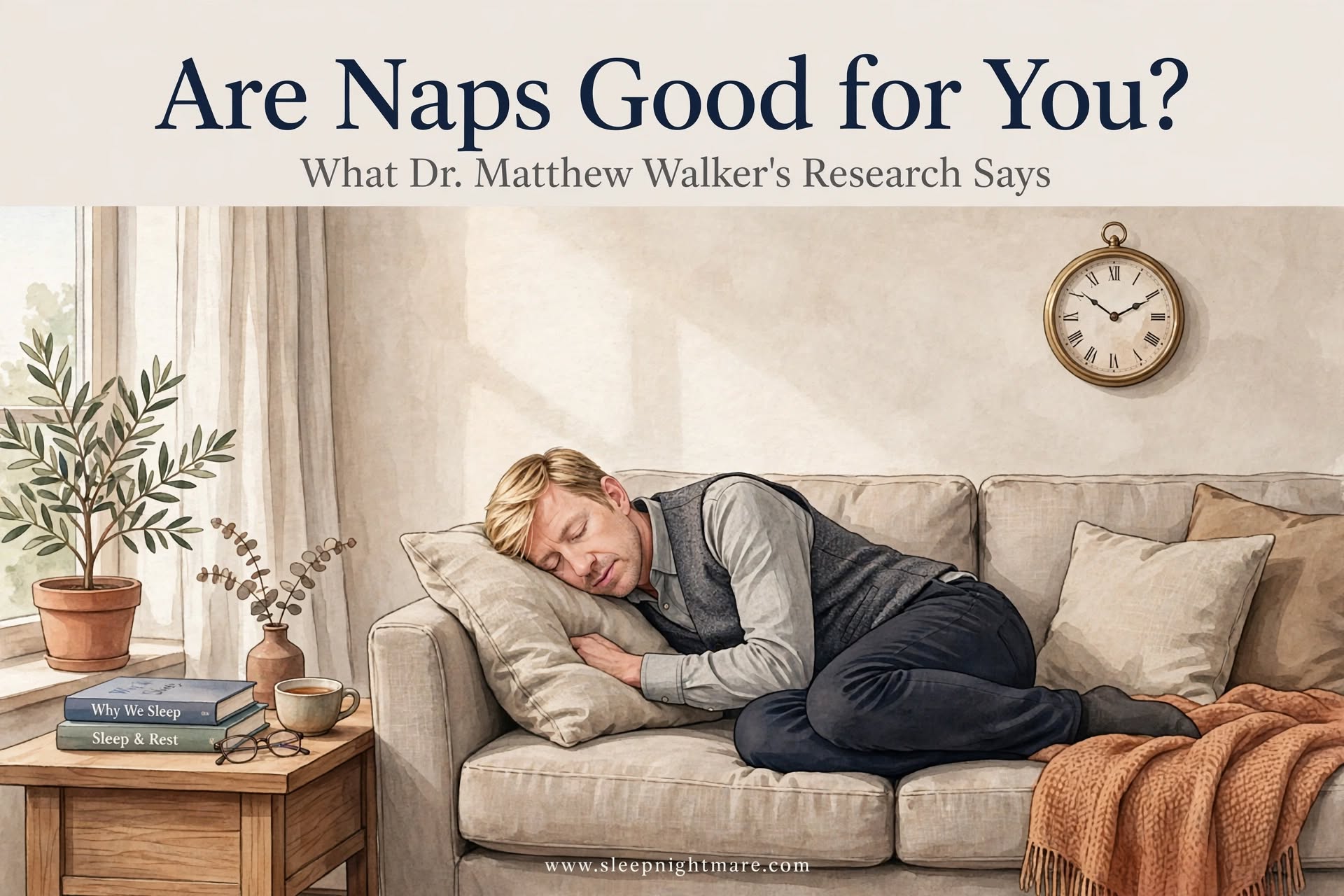
A coffee nap, also called a caffeine nap, means drinking a cup of coffee and then sleeping for roughly 15 to 25 minutes. Dr. Breus calls his version the Napa Latte. The idea is simple. The nap clears sleepiness chemicals while the caffeine is still being absorbed, so both effects arrive together.
Here is how Breus describes the recipe:
“Take a cup of drip black coffee, just throw in a couple of ice cubes, right, merely to cool it down. Drink it as fast as you can, then immediately take a 25-minute nap.” — Dr. Michael Breus
The ice cubes have one job. They cool the coffee so you can finish it fast. That speed matters because caffeine only starts working once your body absorbs it. Breus also specifies plain drip coffee with no extras.
The idea has a research history, too. British researchers tested it on sleepy drivers in the 1990s, and those results appear below. For now, the key point is simple. A coffee nap pairs two fatigue fighters instead of choosing one.
Who Is Dr. Michael Breus?
Dr. Michael Breus is a clinical psychologist who specializes in sleep. According to his official biography, he is a Diplomate of the American Board of Sleep Medicine and a Fellow of the American Academy of Sleep Medicine. He earned his PhD in clinical psychology at the University of Georgia. He also wrote The Power of When and served as WebMD’s sleep expert for fourteen years.
Two details deserve context. First, Breus is a psychologist rather than a medical doctor, and his bio says he passed the sleep specialty board without attending medical school. Second, a retail author profile describes him as the creator of a mattress and pillow line. Because experts who sell products can have commercial interests, this article checks his claims against independent research.
How Does Sleep Work? Sleep Drive vs. Sleep Rhythm
Sleep runs on two separate brain systems, according to Dr. Breus: a sleep drive and a sleep rhythm. The sleep drive builds the longer you stay awake. The sleep rhythm keeps time of day. Researchers describe a similar split in the two-process model of sleep regulation.
Breus opens with a promise to keep things simple:
“There’s only a few things that are truly important to understand about sleep.” — Dr. Michael Breus
He then compares the first system to hunger:
“Sleep drive is like hunger because, right, I’m hungry, I’m hungry, I’m hungry, I eat something and that hunger begins to dissipate. Same holds true with sleep.” — Dr. Michael Breus
In this analogy, eating relieves hunger just as sleeping relieves sleep drive. Scientists call this process sleep homeostasis. A 2012 review describes drowsiness and sleep pressure as its behavioral signs. The review adds that, once sleep is allowed, a rebound compensates for earlier deprivation. As Breus puts it, “The longer you stay awake, the more sleepy that you get.”
Researchers formalize the pairing as the two-process model, a framework credited to Borbély in 1980. The rhythm side, which sleep scientists call the circadian rhythm, sets the timing. The 1997 coffee-nap study captured it in action. Driving incidents and EEG measures of sleepiness all peaked in the mid-afternoon, according to the study abstract.
What Does Adenosine Have to Do With Sleepiness?
Adenosine is a brain chemical that builds up while you are awake and makes you feel sleepy. Researchers widely accept it as a sleep-regulating substance. Sleep gradually lowers its levels again. That rise and fall helps explain what Dr. Breus calls sleep drive.
Breus describes where adenosine comes from. When a cell uses glucose, he says, adenosine comes out of the process. Then it travels to a specific receptor area in the brain. His summary is blunt:
“As adenosine accumulates, you get sleepier and sleepier and sleepier.” — Dr. Michael Breus
Scientists describe the chain slightly differently. A PubMed Central review on caffeine and sleep homeostasis explains that higher energy demand during wakefulness breaks down ATP, the cell’s energy molecule, into adenosine. So Breus’s energy-use idea holds up.
A physiology-of-sleep review adds that adenosine accumulates in the basal forebrain during wakefulness and diminishes with ongoing sleep. Think of adenosine as a sleep gauge. The longer you stay awake, the higher it climbs, and sleep resets it.
Researchers still debate the details, however. A 2022 review in the Journal of Sleep Research lists open questions about exactly how adenosine and caffeine regulate sleep. The core story is solid. The fine print is still being written.
How Does Caffeine Block Sleepiness?
Caffeine blocks adenosine receptors, so adenosine cannot deliver its sleepy signal. It does not remove adenosine from the brain. Instead, it occupies the docking sites. Scientific reviews classify caffeine as an adenosine receptor antagonist, acting mainly on the A1 and A2A receptor types.
Breus explains the mechanism this way:
“Caffeine, since it’s so close in molecular structure, can fit into that receptor site. It blocks any new adenosine.” — Dr. Michael Breus
He also says the two molecules are “off by one molecule.” That is a handy shorthand, not a precise chemistry fact. The National Academies’ caffeine report says caffeine and other methylxanthines structurally resemble the purines, the chemical family adenosine belongs to. That resemblance lets caffeine dock at the same receptors without delivering the sleepy signal.
The receptor details come from a review of adenosine and sleep. It describes caffeine as a nonselective adenosine antagonist that acts primarily at two of the four receptor subtypes. Caffeine blocks the signal rather than clearing its source. That distinction explains why the nap comes first.
How Does the Coffee Nap Sequence Work?
A coffee nap works in two steps. First, the nap lowers adenosine, which reduces your sleep pressure. Then caffeine arrives and blocks the receptors for whatever adenosine remains. Together, the steps remove sleepiness and block its return, according to Dr. Breus.
Breus claims the nap does the first job:
“The adenosine that’s built up in your brain will burn through while you’re napping.” — Dr. Michael Breus
He gives a typical scenario. It is two o’clock in the afternoon, you slept only four hours, and you are dragging. After a 25-minute nap, he says, you burn through a lot of the built-up adenosine. Then “caffeine fits in and blocks any additional adenosine from coming in.” Adding caffeine to the situation sends energy “straight up,” in his words.
The nap half has scientific support. The physiology review above says adenosine diminishes with ongoing sleep. However, the coffee-nap studies cited here measured driving performance, EEG activity, and self-reported sleepiness. They did not measure adenosine itself. The adenosine explanation is plausible, but the studies did not test it directly.
Why Does Caffeine Take So Long to Kick In?
Caffeine takes time to build up, so it does not work the moment you swallow it. Reference data show blood levels peak between 15 and 120 minutes after drinking it. Dr. Breus cites 25 to 30 minutes. That delay is the window a coffee nap uses.
Many people believe coffee works instantly. Breus disagrees:
“That’s really not actually how caffeine works. It has to go down, it has to get absorbed, it has to be digested.” — Dr. Michael Breus
The science agrees with the principle. The National Academies’ report says peak plasma concentrations occur between 15 and 120 minutes after oral ingestion. It also reports that caffeine’s half-life averages about five hours but can range from 1.5 to 9.5 hours.
Because the range is wide, your own timing may differ. A 25-minute nap is therefore a good guide, not a precise rule. If caffeine hits you slowly, you may still be napping when it peaks. If it hits you fast, you may feel it as you wake. Either way, the nap and the caffeine overlap better than they would if you waited.
What Does the Research Say About Coffee Naps?
Controlled studies support the coffee nap for short-term alertness. British researchers found that combining 200 mg of caffeine with a nap cut driving incidents to 9% of placebo levels. Caffeine alone cut them to 34%. The participants were sleepy drivers, not office workers.
Here is what the main studies found:
- Horne and Reyner, 1996: Ten sleepy participants, limited to five hours of sleep, received a nap under 15 minutes, 150 mg of caffeine, or a placebo during a rest break between two one-hour monotonous drives. Caffeine and the nap each reduced driving impairment, sleepiness, and EEG signs of drowsiness for the full hour. Caffeine worked more consistently, because not everyone naps easily. (TRL report)
- Reyner and Horne, 1997: The combination cut driving incidents to 9% of placebo levels, versus 34% for caffeine alone. Even naps made up of “nonsleep dozing” still helped. (Psychophysiology abstract)
- Horne and Reyner, 1999 review: The only safe countermeasure to driver sleepiness is to stop driving. A 30-minute break that includes a short nap, under 15 minutes, or coffee can help. (Occupational and Environmental Medicine)
Now compare those results with Breus’s promise:
“You’re good for four hours, guaranteed.” — Dr. Michael Breus
The studies above tracked about one hour of alertness. The four-hour figure is his claim, and the research cited here does not test it.
Is a Coffee Nap a Substitute for Sleep?
No, a coffee nap does not replace a full night of sleep. The studies measured short-term alertness, not recovery from sleep debt. Breus frames it as a tool for days when you slept only three or four hours and still must perform.
He mentions a big presentation or an award ceremony as examples. In those moments, a coffee nap can help you feel much better, he says. The 1996 study fits that picture. Researchers restricted participants to five hours of sleep the night before, so the method was tested after one short night, not chronic sleep loss.
If you feel exhausted most days, see a doctor. Persistent daytime sleepiness can have medical causes that no coffee nap will fix.
How Can I Easily Take a Nap? A Step-by-Step Method
To take a nap easily, keep the routine simple: drink a cup of black coffee quickly, then lie down for 15 to 25 minutes with an alarm set. Dr. Breus suggests adding ice to cool the drink. Sleep experts say short naps avoid deep sleep and the grogginess that follows.
Follow these steps:
- Brew plain drip coffee. Breus specifies black coffee.
- Add a couple of ice cubes. They cool the cup so you can finish it quickly.
- Drink it fast. Breus says to drink it “as fast as you can.”
- Lie down immediately and set an alarm. Aim for about 20 to 25 minutes.
- Wake up and move. Give yourself a few minutes to shake off any grogginess.
The alarm matters more than it seems. Cleveland Clinic explains that sleep inertia tends to hit when you wake abruptly from deep sleep, leaving you groggy, confused, and unrefreshed. A 15-to-20-minute power nap keeps you in lighter stages. Moreover, the clinic advises napping earlier in the day and warns that naps longer than an hour can wreak havoc on nighttime sleep.
Also, do not panic if you only doze. The 1997 study found that naps made up of nonsleep dozing were still effective.
When Should You Skip a Coffee Nap?
Skip the coffee nap late in the day. A 2013 study found that 400 mg of caffeine taken six hours before bed cut total sleep time by more than an hour, and participants seemed unaware. Caffeine’s half-life averages about five hours, so afternoon doses can linger into the night.
That 2013 study, in the Journal of Clinical Sleep Medicine, gave 12 healthy sleepers 400 mg of caffeine at bedtime, three hours before, or six hours before. The authors concluded that avoiding substantial caffeine for at least six hours before bed is supported by their data.
A single cup holds less. The FDA lists 113 to 247 mg for a 12-ounce cup of regular brewed coffee. It also cites 400 mg a day as an amount not generally associated with negative effects for most adults. Too much caffeine can cause jitters, heart palpitations, and sleep disruptions, and sensitivity varies from person to person.
Timing and safety are the two big rules. Do your coffee nap in the early afternoon, not the evening. Also, treat it as a break strategy, not a driving strategy. If you feel sleepy behind the wheel, the 1999 review says the safe move is to stop and take a break.
Conclusion
The coffee nap is less strange than it sounds. Dr. Breus’s core logic fits what researchers know about adenosine. Nap to lower sleep pressure, then let caffeine block the leftover signal. The strongest evidence comes from sleepy-driver studies showing short-term gains in alertness.
His “four hours, guaranteed” promise and “off by one molecule” shorthand go further than the data. So treat the Napa Latte as a smart short-term tool. Brew black coffee, nap for about 20 minutes, and do it early in the day. If you need it constantly, talk to a doctor about why you are so tired.
Frequently Asked Questions
What is a coffee nap?
A coffee nap means drinking caffeine and immediately taking a short nap, about 15 to 25 minutes. Dr. Breus calls his version the Napa Latte. The nap lowers sleep pressure while caffeine absorbs, so alertness returns as you wake. Studies of sleepy drivers support the approach for short-term alertness.
Does a coffee nap work better than coffee alone?
In a 1997 study of sleepy drivers, caffeine plus a short nap reduced driving incidents to 9% of placebo levels. Caffeine alone reduced them to 34%. The combination therefore outperformed caffeine alone. However, it tested sleepy drivers, so results may differ for other tasks. (Psychophysiology, 1997)
What is adenosine and why does it make you sleepy?
Adenosine is a brain chemical that accumulates while you are awake. Researchers widely accept it as a sleep-regulating substance, and it acts through receptors in the brain. Sleep gradually lowers its levels. Caffeine blocks those receptors, which is why it reduces the feeling of sleepiness without removing adenosine. (Journal of Sleep Research, 2022)
How long should a coffee nap be?
Aim for roughly 15 to 25 minutes. Cleveland Clinic recommends 15 to 20 minutes for a power nap, because longer naps raise the chance of deep sleep and sleep inertia, the groggy feeling after waking. Set an alarm so you do not oversleep, and nap earlier in the day. (Cleveland Clinic)
Is caffeine before a nap safe for sleep at night?
For most adults, one cup falls well below the FDA’s 400 mg daily benchmark, an amount not generally associated with negative effects. However, caffeine late in the day can disrupt night sleep. A 2013 study found 400 mg six hours before bed cut total sleep time by over an hour. (FDA; JCSM, 2013)
How can I easily take a nap if I cannot fall asleep?
You may not need to fall fully asleep. In the 1997 study, naps made up of nonsleep dozing were still effective. Caffeine also produced more consistent effects than napping in an earlier driver study, because not everyone naps easily. So resting quietly for 20 minutes may still help, even if you do not fully sleep. (TRL report)
Sources
- Reyner LA, Horne JA. Suppression of sleepiness in drivers: combination of caffeine with a short nap. Psychophysiology. 1997;34(6):721-725.
- Horne JA, Reyner LA. Falling asleep at the wheel (TRL Report 168). Transport Research Laboratory, 1995. Related paper: Psychophysiology. 1996;33(3):306-309.
- Horne J, Reyner L. Vehicle accidents related to sleep: a review. Occupational and Environmental Medicine. 1999;56(5):289-294.
- Reichert CF, Deboer T, Landolt HP. Adenosine, caffeine, and sleep-wake regulation: state of the science and perspectives. Journal of Sleep Research. 2022;31(4):e13597.
- Caffeine, the circadian clock, and sleep homeostasis review. PubMed Central.
- Adenosine and the regulation of sleep review. PubMed Central.
- Carley DW, Farabi SS. Physiology of sleep. PubMed Central, 2016.
- Adenosine and homeostatic control of sleep. Revista de Neurología. 2012;55(7):413-420.
- National Academies Press. Pharmacology of caffeine. In Caffeine for the Sustainment of Mental Task Performance. NCBI Bookshelf.
- Drake C, Roehrs T, Shambroom J, Roth T. Caffeine effects on sleep taken 0, 3, or 6 hours before going to bed. Journal of Clinical Sleep Medicine. 2013;9(11):1195-1200.
- U.S. Food and Drug Administration. Spilling the beans: how much caffeine is too much?
- Cleveland Clinic. What’s the ideal length for a nap? July 2025.
- The Sleep Doctor. Dr. Michael Breus biography.
No Comments